
Tip the Scales Against Psychosis: Highlights from Our Conversation with Dr. Deanna L. Kelly
A recap of our session exploring clozapine, the most effective antipsychotic medication available, and why so many families affected by treatment-resistant schizophrenia have never heard of it.
Doro Mind Team
Doro Mind · May 21, 2026
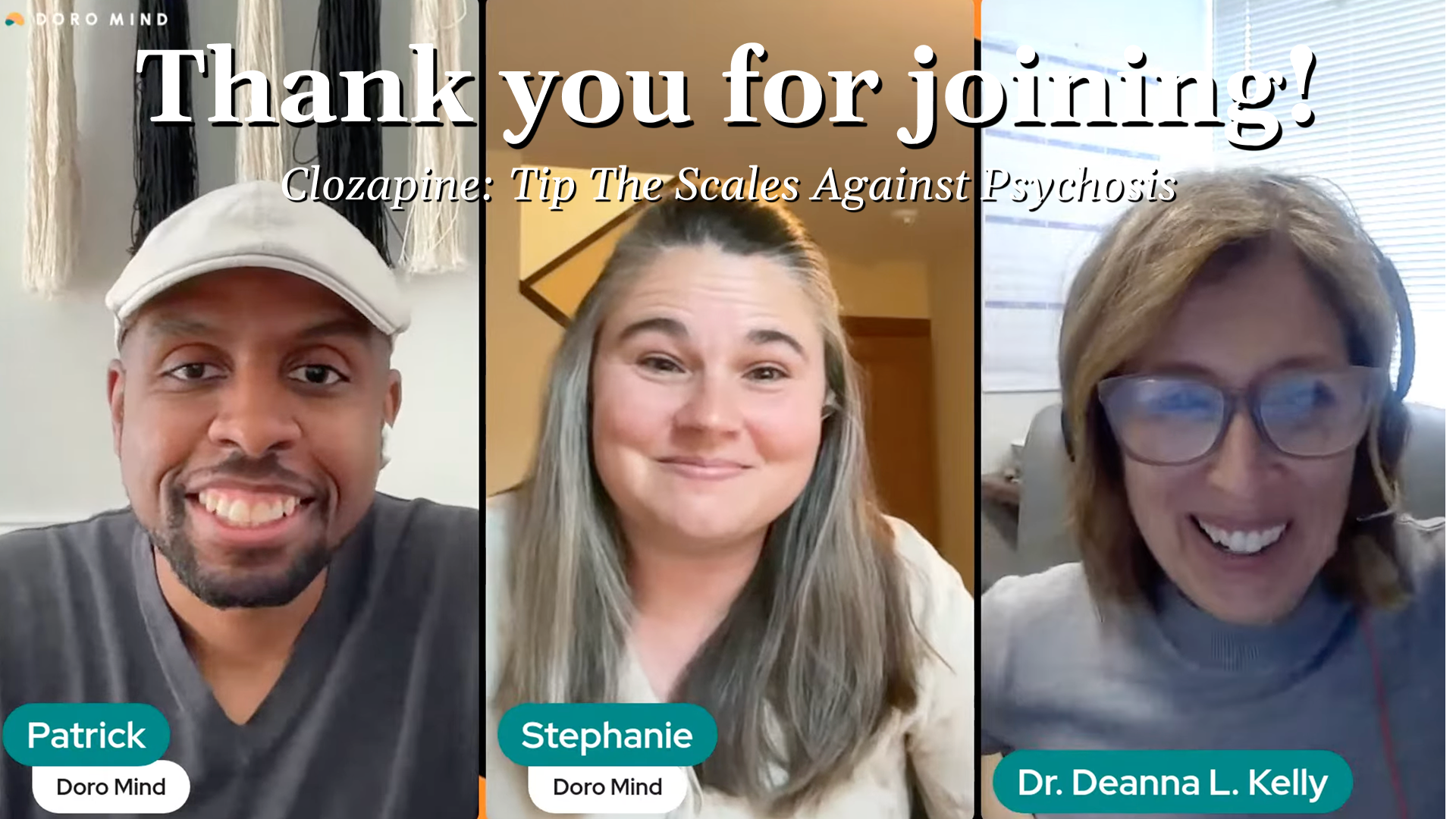
Thank you to those who joined us live for our conversation on clozapine with Dr. Deanna L. Kelly, and to the 73 people who submitted questions ahead of the event. That's the most pre-submits we have received since we began these conversations. We are especially grateful to Dr. Kelly for the clarity she brought to this topic.
Dr. Kelly is a Professor of Psychiatry at the University of Maryland School of Medicine and Director of the Maryland Psychiatric Research Center, where for nearly three decades she has worked to tear down the barriers that keep effective treatment out of reach for the families who need it most.
You can watch the full replay and share your reflections via the links below:
→ Watch the Replay
→ Share Your Feedback
The Barriers To Clozapine Access
Dr. Kelly began her career working with clozapine in an era when the field was moving in the opposite direction, rushing toward newer antipsychotics flooding the market and sidelining the medication she knew worked best. Thirty years later, she is still working to undo that sidelining. What makes her the right voice for this conversation is not just her research but the way she's willing to name every barrier and how she is working to dismantle them.
During our conversation, several specific patterns emerged that explain why families have not been told about clozapine, and what we can do about that:
The Recommended Treatment That Gets Called a Last Resort
In clinical guidelines from the American Psychiatric Association and many international bodies, clozapine is the recommended first-line treatment once someone has not responded to two other antipsychotics. The "last resort" framing is a product of history, not evidence.
In all the guidelines that are out there, including the American Psychiatric Association guidelines and many worldwide guidelines, clozapine is slated to be the first-line agent for treatment-resistant schizophrenia. Meaning, you've failed two trials, this is the first thing you should be trying... It has then become, in some people's training, the 'last resort', when in fact, this is first-line treatment for treatment-resistant schizophrenia.
The gap between what the guidelines say and what families hear is not a scientific gap. It is a training gap and a habit gap. Dr. Kelly has spent her career working to close these gaps.
The Blood Test Fear
Clozapine's blood monitoring requirement originated from a rare cluster of cases in Finland in the 1970s. The condition at the center of that fear, severe neutropenia, occurs in less than one percent of individuals. Dr. Kelly pointed out that the same risk profile for amoxicillin, the antibiotic most of us have taken for a sore throat, is actually higher.
Severe neutropenia occurs in less than 1% [of individuals.] A medication like amoxicillin, which is an antibiotic you might have taken for an ear infection or sore throat or strep throat, has a higher risk.
The formal REMS monitoring program has since been discontinued. The fear it created has not relaxed at the same pace. Understanding where the risk actually sits is a first step toward a different conversation with a prescriber.
The Prescriber Comfort Barrier
For many families, the barrier is not finding a doctor willing to discuss clozapine, but rather finding one who feels trained enough to prescribe it. Dr. Kelly hears this directly from her colleagues.
Physicians will say to me: 'Well, I want [my patient] to be on clozapine. If your team does it, I'm on board, but I don't know if I can do it.'
The same dynamic plays out around blood draws: providers often assume individuals will not comply, when compliance rates are much higher than anticipated. The barriers, Dr. Kelly emphasized throughout the conversation, are as much about perception as logistics. Walking into an appointment already knowing that clozapine is first-line, and that the monitoring landscape has changed, gives families a real foothold in that conversation.
The Advocates Who Move This Faster Than Research Can
The final pattern Dr. Kelly named is perhaps the most important one: the families and peer specialists who share their stories are changing the landscape of clozapine access faster than any research publication can.
They're changing the world more than anyone because they're sharing their stories and talking to others about it... I'm sure all of you who are doing better would love to say, 'Gosh, I wish I would have gotten clozapine sooner.' And that's what I hear almost every time when someone says, 'What was the issue? What were you worried about?' And everyone says, 'If only I could have had it earlier in care.'
Insights from the Community
The audience that joined us brought a depth of engagement that shaped the entire Q&A. One viewer wrote in the chat that she was starting clozapine that night. Her question, brought on-air by Stephanie: "What are some motivation factors for someone who struggles with medication compliance?" Her father, she said, was nervous she would quit.
Dr. Kelly's response was: "I forgot to take my vitamin this morning, you know, so this is hard. We all forget." She walked through practical strategies: routine, reminders, small rewards, timing the dose so sedation peaks while you are asleep. But the core of her answer was: stay the course long enough for the medication to find its level. Side effects can be managed. Doses can be adjusted. Do not just stop, she said. Reach out for support first.
By the end of the session, the chat had filled with support from other viewers. Two separate viewers mentioned family members who had been on clozapine for decades and were doing well. The long-term safety data, Dr. Kelly confirmed, looks very good.
Dr. Kelly closed with this: "Hope," she said, "is not just a wish. It is a desire paired with the expectation that good things are in store." Clozapine, in her framing, is one of the things that can give families the expectation of good things. Nearly thirty years of her career have been spent making sure more families get a chance at hope.
Ready to start your journey?
If you are looking for a partner to walk alongside you through the complexities of treatment-resistant SMI care, start the conversation with us.
Stay connected with Dr. Kelly by bookmarking her website and following her on LinkedIn or Instagram (@dr.deanna.kelly).
Share your thoughts
We would love to hear what you are taking away from this conversation. Share your reflections here.
About the Author
Doro Mind Team
Doro Mind
Doro Mind is a mental health service provider partnering with families to treat schizophrenia, bipolar disorder, and related brain disorders through expert clinical care and compassionate support.
Related Reading
More on Company
Company
Fellow Travelers: Highlights from Our Conversation with Stephanie Greer
A recap of our conversation about what roughly 290 first calls with families taught Stephanie Greer, and the next chapter she is beginning as a family therapist.
READCompany
Doro Mind Receives NIH Grant to Address the Intersection of Substance Use and Serious Mental Illness
Doro Mind has been awarded a grant from the National Institutes of Health (NIH) to develop a digital platform targeting the relationship between substance use and serious mental illness.
READNeed support for your family?
Our team is here to help you navigate serious mental illness, with expert care and compassion.