
The False Finish Line: Highlights from Our Conversation with Hannah Bottigheimer
A recap of our session exploring the "false finish line," a common experience where hospital discharge feels like the end of a crisis but actually marks the beginning of the long, invisible labor of home recovery.
Doro Mind Team
Doro Mind · April 10, 2026
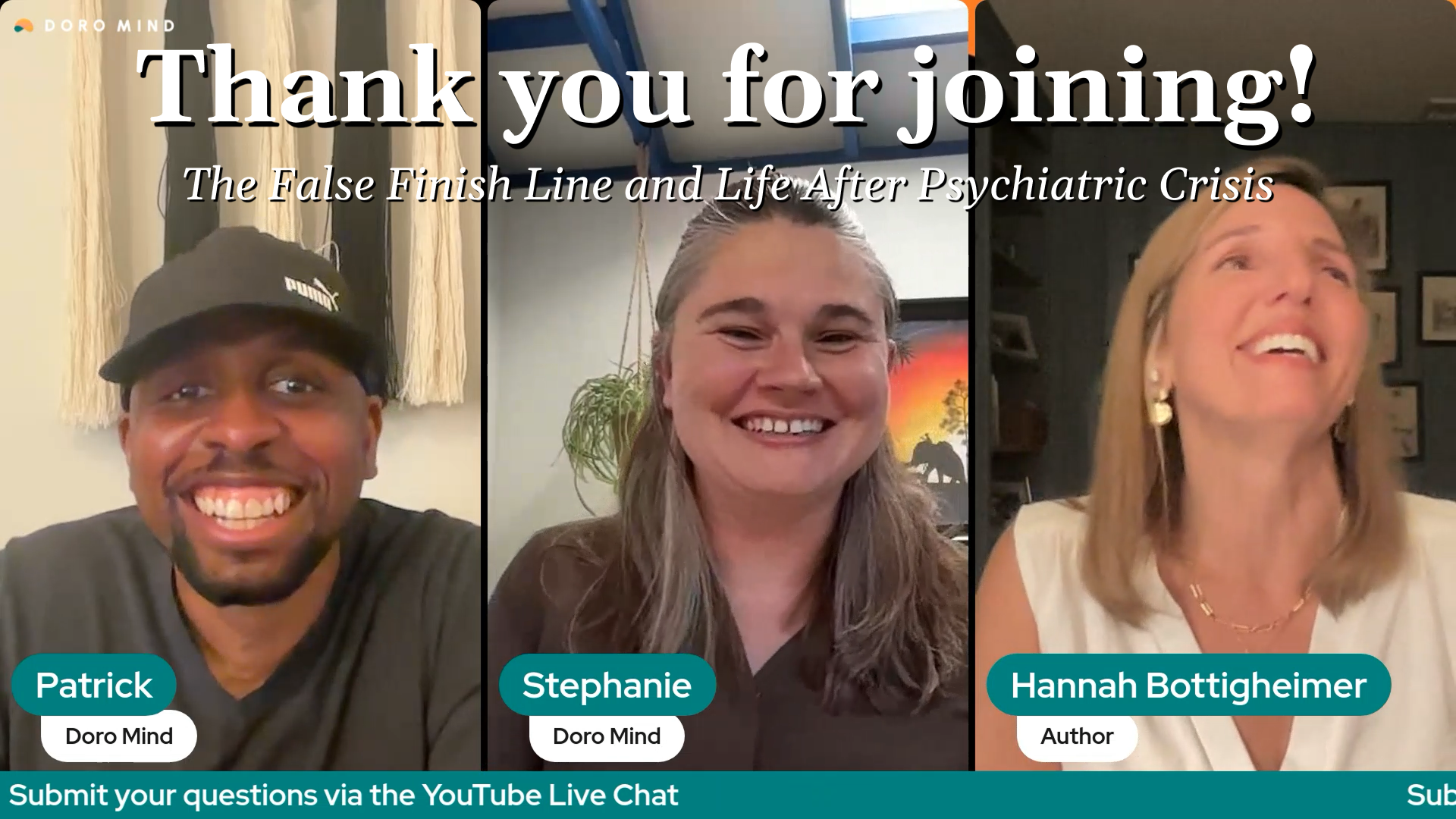
We want to start by saying a thank you to everyone who joined us live for our conversation with author Hannah Bottigheimer. With well over 125 people joining virtually and 70+ questions submitted, it is clear that the reality of the "false finish line" is a weight many of our families are carrying in silence.
If you missed the session or want to revisit Hannah's insights on reclaiming selfhood after a crisis, you can watch the full replay here.
The Patterns of the "False Finish Line"
In the thick of a psychiatric emergency, we are wired for survival. We treat milestones, such as a hospital discharge or a return to a stable home environment, as the end of the race. Hannah shared candidly about her daughter Sarah's journey through six hospitalizations and the sudden realization that bringing her home was not the end of the crisis. It was the beginning of a different, more invisible kind of labor.
During our conversation, several specific patterns emerged that challenge the typical "recovery" narrative:
- The Trap of the "One and Done" Mindset: Hannah reflected on how she initially viewed psychosis as a "passing event." She shared, "I thought, thank goodness that's over. I imagined it was something we might never understand, but that it had a beginning and an end." Acknowledging that recovery is non-linear, requiring us to recalibrate like a GPS every single day, is the first step in moving past the shame of a slow recovery.
- The "Nuclear Option" and the Revolving Door: We discussed the frustration of the revolving door of psychiatrists in clinical settings. Hannah highlighted how the delay in finding the right treatment, such as the medication Clozapine, can prolong a family's trauma. For Sarah, this "nuclear option" was the key to stopping the cycle of aggression and moving into a state of relative stability.
- The Invisible Burden of Safety: Hannah spoke vulnerably about the "shameful and treasonous" feelings that come when a caregiver is afraid of the person they love. She described the cognitive dissonance of being responsible for a child's safety while simultaneously fearing for her own, a reality that many caregivers face but feel they cannot admit to the outside world.
- The Descent of Self-Erasure: Hannah described the heavy realization that she was no longer "moving toward something," but simply retreating from the overwhelm of trying to be two people at once: a full-time employee and a caregiver for a daughter in crisis.
Insights from the Community
The most enlightening moment of the evening came from a discussion about the personal toll of the journey. When asked how to protect one's own health while wanting your life back, Hannah's response was a profound reminder of our shared humanity.
She shared that while she felt "erased" by her responsibilities, her rebirth came through the act of writing. By moving from a place of being "overtaken" by the diagnosis to finding her own voice again through her memoir, The Last Child, she reminded us that reclaiming yourself is a radical act of survival.
Hannah left us with a powerful quote from Viola Davis about the "hero's journey." The final goal is not just surviving the crisis, but returning to ordinary life transformed and sharing that story of survival with others.
Ready to start your journey?
If you are looking for a partner to walk with you through the "false finish lines" of recovery, click here to start a conversation with us or reach out to our team of Guides at guides@doromind.com.
To keep up with Hannah, follow her on Instagram and sign up for her LinkedIn Newsletter.
Share your thoughts
Did a specific part of Hannah's story mirror your own? Or are you interested in next steps? We would love to hear your reflections and goals. You can share your feedback with our team at go.doromind.com/share-feedback-ffl.
About the Author
Doro Mind Team
Doro Mind
Doro Mind is a mental health service provider partnering with families to treat schizophrenia, bipolar disorder, and related brain disorders through expert clinical care and compassionate support.
Related Reading
More on Company
Company
Fellow Travelers: Highlights from Our Conversation with Stephanie Greer
A recap of our conversation about what roughly 290 first calls with families taught Stephanie Greer, and the next chapter she is beginning as a family therapist.
READCompany
Doro Mind Receives NIH Grant to Address the Intersection of Substance Use and Serious Mental Illness
Doro Mind has been awarded a grant from the National Institutes of Health (NIH) to develop a digital platform targeting the relationship between substance use and serious mental illness.
READNeed support for your family?
Our team is here to help you navigate serious mental illness, with expert care and compassion.