
Fellow Travelers: Highlights from Our Conversation with Stephanie Greer
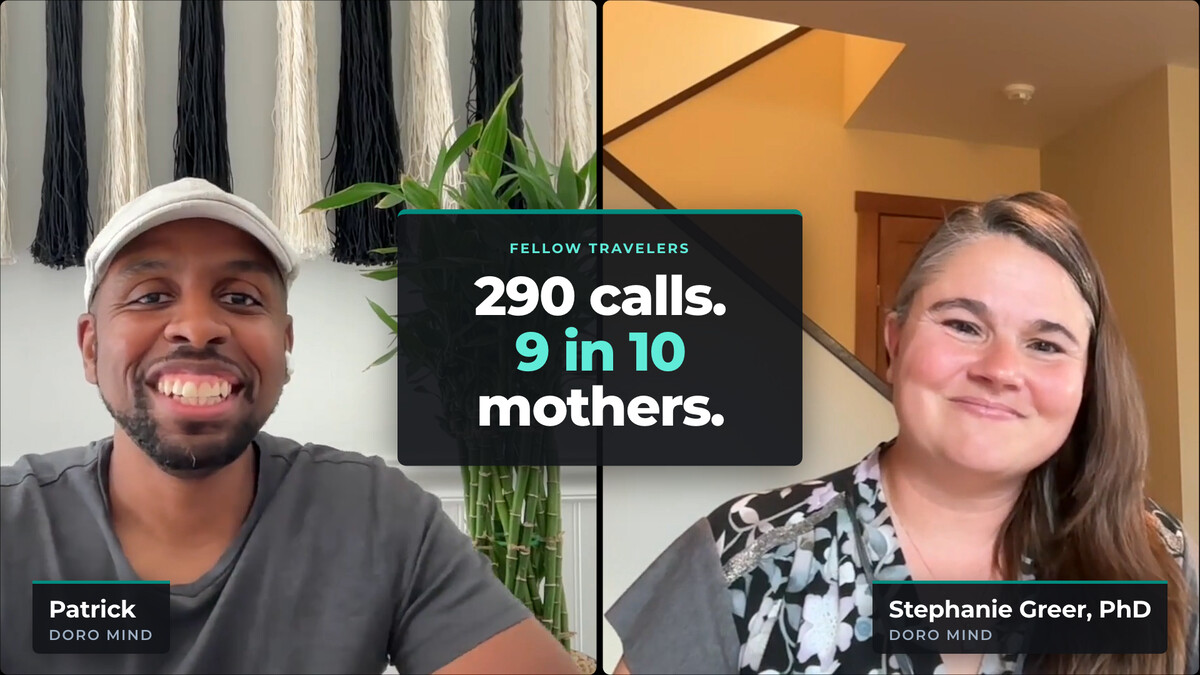
A recap of our conversation about what roughly 290 first calls with families taught Stephanie Greer, and the next chapter she is beginning as a family therapist.
Doro Mind
Doro Mind · August 28, 2026
The short version:
- Stephanie Greer, Doro Mind's Director of Product and a co-founder of Akin, is often the first voice families hear when they reach out.
- Across Akin and Doro Mind, she's taken roughly 290 welcome calls, about nine in ten of them with mothers.
- Stephanie is starting her next chapter: training as a marriage and family therapist while continuing her Open Dialogue studies.
- From what a family's role really is to what Open Dialogue does differently, four patterns ran through our conversation.
- Stephanie closed with a tangible follow-up to "you are not alone": look for fellow travelers, and you will find them.
Event Recap
Thank you to everyone who registered, joined us for the premiere, or shared a warm note for Stephanie. The 47 notes you generously left really touched her.
If you have ever called Doro Mind, there is a good chance Stephanie is the person who picked up. At Doro Mind, and at Akin before that, she has usually been the first person a family talks to, and usually at the moment they were looking for new hope. Stephanie opens with one question: what has happened that has led you to reach out? The answers she hears are rarely short.
A neuroscientist by training and a co-founder of Akin, Stephanie also wrote Many Pathways, twenty-five accounts drawn from her own interviews with individuals and families. Now she is training as a marriage and family therapist at the Wright Institute, while she continues her Open Dialogue studies through the Indico Institute. Patrick sat down with her to record this conversation before she embarks on her next chapter.
→ Watch the full replay
→ Get the companion guide
The Patterns in Stephanie's Story
Often, the path leading to this work starts at home. For Stephanie, it was her mom. As Stephanie has shared openly, in the past and in this interview, her mom lives with bipolar disorder, and had severe psychotic episodes throughout Stephanie's early childhood. Finding treatment that held by the time Stephanie was twelve changed all of that. Watching and experiencing both sides, the crisis and then the recovery, Stephanie stepped into neuroscience and eventually into building family education at Akin. That's where the plan changed.
Silence Is a Response Too
Patrick asked what she wished families understood about their own role. Stephanie has spent six years inside that question.
It's a bind for family members, because a silence is a response. Engagement is a response. Listening is a response. And those things matter and have an impact. But you matter too.
That last sentence is the one families tend to skip past. Stephanie shared something she believes more strongly every year: recovery happens in collaboration. That means collaboration with your loved one, and with a treatment team willing to work alongside you rather than around you.
The Holes Are Sewn Into the Net
At Akin, Stephanie was building education for families, and the calls revealed something she had not expected. Families she spoke with understood the illness well enough. Treatment was the thing they could not get ahold of, and it turned out to be what was missing most.
There is a line she borrowed from Lost Patients, the series from The Seattle Times and KUOW:
It's not that the system's broken, it's that there are holes that are sewn into our safety nets.
Sewn is the useful word. A hole that is stitched into something sits in the same place every time, and a place you can name is a place you can watch for. Stephanie named three:
- 1More than half of US counties have no practicing psychiatrist.
- 2The 72 hours after a hospital discharge carry the highest risk of suicide.
- 3Emergency rooms will hold someone for days waiting on a psychiatrist to come see them.
Knowing where they sit lets you ask about them in advance.
Families Are the Care Team
Stephanie met Mimi Liu at a conference, back when Mimi and Brady were still gathering the first few people for Doro Mind. Their idea was care designed around the whole family rather than around one person. Coming from the opposite direction, Stephanie had reached the same conclusion, and that's why she joined.
We really connected over the value of family in care journeys and the need to support families and think about these as multiplayer, not single player care journeys.
Treating a family as part of the team leads straight to continuity, something Stephanie experienced up close. Her mother saw the same psychiatrist for years. When he retired, the loss of that one relationship was its own kind of setback, which families tend to understand long before the system does.
It's also what families tell her when something finally works. One of her favorite things a Doro Mind member has ever said:
Finally, people who really get it.
Immediate Help Is the Missing Piece
Stephanie shared that Open Dialogue began in Western Lapland, in the north of Finland, back in the 1980s. Its local system was under-resourced and hospitalizing people through every crisis. So they tried the opposite. Instead of admitting someone, they sent two practitioners out to the family's home at the moment things were hardest. The results that made the model known are promising rather than settled, and the companion guide walks through what they do and do not show.
Patrick asked which of the seven principles Stephanie would most want the wider system to take seriously. Her answer was the social network perspective first, and then, more urgently, immediate help. A psychiatrist from the original program told her trainees that if she had to bet on the one thing that made the difference, it would be the ability to answer the phone and be there within a day.
Psychosis in particular is just not treated like something that needs immediate attention. And that feels dismissive.
Stephanie was quick to say that this is not an argument against medication. On the contrary, medication changed her mother's life.
It's not an either or with psychosocial approaches and medication approaches. It's a both and.
When we recorded the interview, Stephanie mentioned a large NHS randomized trial that was still pending. Those results have since published. In the trial, Open Dialogue did not show a significant difference in time to a first relapse. However it was associated with fewer psychiatric inpatient admissions and with better self-rated recovery, quality of life, and satisfaction with care. The authors describe those as findings that need further investigation.
Insights from the Community
Forty-seven of you wrote in when you registered, and similar questions came up again and again. Afterward, Stephanie answered several of them in chat.
How do I help my son get moving again, without pushing too hard?
Five registrants asked a version of this, whether it was doing activities together, socializing, or more independence at home.
This issue of stillness or lack of motivation is a theme I often hear from families and can be one of the hardest to bear witness to. Starting with patience and compassion (both for yourself and your loved one) is of course important... I find Pat Deegan's work on this issue and her methods around personal medicine to be particularly interesting.
How do you help someone who does not believe they are ill?
Five registrants (and one person live in chat) asked about anosognosia, and about a loved one refusing treatment because of it.
Stephanie shared that her thinking on this has shifted more than on anything else. Instead of answering with a technique, she pointed to something her Akin co-founder Matt Montañez wrote about helping someone who hears voices:
I've spent countless hours trying to convince my brother that the voices in his head weren't real. Years later, he's convinced me that they are.
If we hope our loved one will come to see something differently, Stephanie said, we have to stay open to seeing something differently ourselves. On this she has written a practical guide for families, and plans to write more.
Where can a family actually find Open Dialogue in the US?
Three registrants went straight to this one.
This type of resource is indeed hard to find, especially in the US. The larger practices that I know of are at Advocates in MA and CSAC in VT. I'd welcome any messages from folks looking for this type of support and I may be able to help uncover the next stone.
Fellow Travelers
To close out the interview, Patrick asked Stephanie what she wanted to leave you all with. In answering, Stephanie reached for a phrase most families here have heard many times.
There's a lot of messages that say you're not alone. And it's true... and so rather than say you're not alone, I would say if you want to find fellow travelers, if you want to find folks that have shared some of what you've been through, they're out there, and they're findable.
Both halves are the whole of it. You are not alone on this road, and that is true and worth hearing. What Stephanie adds is where to go looking, and her word that the looking works.
Ready to start your journey?
If you are looking for a partner to walk with you through this journey toward meaningful recovery, start a conversation with us or reach out to our team of Guides at guides@doromind.com.
Stephanie plans to write more about Open Dialogue in the coming months. Follow along with her on LinkedIn.
About the Author
Doro Mind
Doro Mind
Doro Mind is a mental health service provider partnering with families to treat schizophrenia, bipolar disorder, and related brain disorders through expert clinical care and compassionate support.
Related Reading
More on Company
Company
Doro Mind Receives NIH Grant to Address the Intersection of Substance Use and Serious Mental Illness
Doro Mind has been awarded a grant from the National Institutes of Health (NIH) to develop a digital platform targeting the relationship between substance use and serious mental illness.
READCompany
What We Learned at NAMICon 2026
Reflections from the Doro Mind team on four themes that stayed with us after NAMICon 2026 in Atlanta — lived experience as a change agent, the power of seeing recovery in person, the enormous burden on caregivers, and what it really takes to build a whole-team approach.
READNeed support for your family?
Our team is here to help you navigate serious mental illness, with expert care and compassion.